Unlocking the Meaning of Abstract Art
meaning of abstract art

Unlocking the Meaning of Abstract Art

Explore the profound world of non-representational art and discover how to connect with its emotional and intellectual depth.

Start Your Journey

Key Takeaways

  • ✓ Abstract art does not attempt to represent external reality accurately.
  • ✓ It often focuses on color, form, line, and texture to evoke emotion or convey ideas.
  • ✓ Pioneers like Kandinsky and Mondrian laid foundational theories for abstraction.
  • ✓ Interpretation is highly personal, emphasizing the viewer's experience.
  • ✓ Abstract art challenges traditional notions of beauty and artistic skill.

How It Works

1
Engage Your Senses

Approach abstract art with an open mind, allowing colors, shapes, and textures to stimulate your visual and emotional responses. Don't immediately search for recognizable objects.

2
Consider the Artist's Intent

Research the artist, their background, and statements about their work if available. This context can offer valuable insights into their motivations and the themes they explore.

3
Reflect on Your Emotions

Pay attention to the feelings, thoughts, and memories the artwork evokes within you. Abstract art often aims to communicate on a non-verbal, visceral level.

4
Explore Formal Elements

Analyze the composition, balance, rhythm, and interplay of lines, shapes, and colors. These elements are the 'language' through which abstract artists communicate.

The Elusive Essence: What is Abstract Art Truly About?
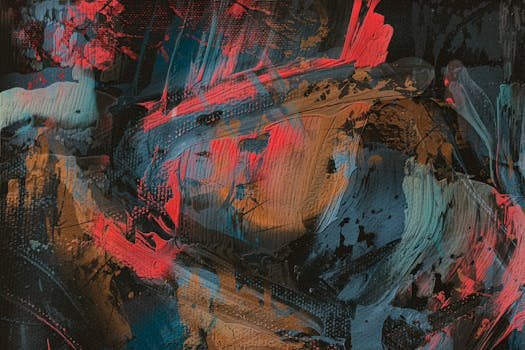
Vibrant abstract expressionist art with bold colors and dynamic brush strokes. Photo: Steve A Johnson / Pexels
The meaning of abstract art often feels like a riddle, a visual puzzle challenging our deeply ingrained desire to recognize and categorize. Unlike representational art, which aims to depict subjects from reality, abstract art deliberately moves away from objective representation. It doesn't show you a tree, a person, or a landscape in a literal sense. Instead, it invites you into a realm of pure form, color, line, and texture, where the visual elements themselves become the subject. This departure from the tangible can be unsettling for some, while for others, it opens up a world of unparalleled expressive freedom and intellectual engagement. At its core, abstract art seeks to communicate ideas, emotions, or spiritual states directly, bypassing the need for a narrative or a recognizable object. It's a language of sensation, intuition, and introspection. Think of music – you don't need to see a violin or a piano to feel the emotion of a symphony. Abstract art operates on a similar principle, using visual harmonies and dissonances to resonate with the viewer's inner world. It's not about 'what' you see, but 'how' it makes you feel, 'what' it makes you think, and 'where' it transports your imagination. This foundational shift in artistic purpose is what makes understanding the meaning of abstract art such a profound and personal journey. It’s a call to engage not just your eyes, but your mind and spirit, to find connections and significance in the interplay of non-objective forms. The beauty lies in its multiplicity of interpretations, where each viewer becomes an active participant in shaping the artwork's meaning. It challenges our preconceived notions of what art should be, pushing boundaries and expanding the very definition of creativity. This constant re-evaluation of artistic purpose is one of the most compelling aspects of abstraction, making it a vibrant and ever-evolving field within the broader world of arts. It asks us to look beyond the surface, to delve into the artist's internal landscape, and perhaps, to discover something new about our own. It's a conversation without words, a dialogue between the canvas and the consciousness, where the abstract forms serve as catalysts for subjective experience.

A Journey Through Time: The Evolution of Abstraction
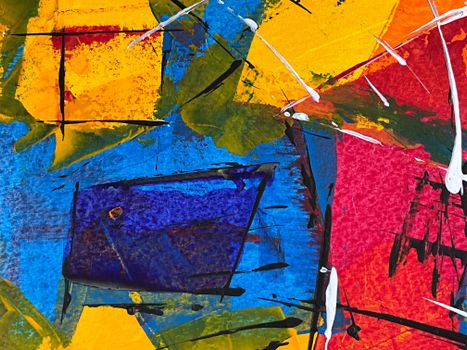
Dynamic abstract painting featuring vivid colors and bold, expressive brushstrokes. Photo: Steve A Johnson / Pexels
To truly grasp the meaning of abstract art, it's essential to trace its historical roots and understand the intellectual and cultural currents that gave rise to it. While elements of abstraction can be found in ancient and non-Western art, the modern abstract movement largely emerged in the early 20th century, a period marked by rapid industrialization, scientific breakthroughs, and profound societal shifts. Artists felt a growing need to express the complexities of a changing world that traditional representational forms could no longer adequately capture. Wassily Kandinsky is widely credited with creating one of the first purely abstract paintings around 1910. He believed that art should express inner spiritual necessities, much like music, and that colors and forms possessed their own intrinsic emotional and spiritual vibrations. His theory of 'Concerning the Spiritual in Art' became a foundational text for abstract expression. Concurrently, movements like Cubism, led by Picasso and Braque, began to deconstruct objects into geometric forms, fragmenting reality and paving the way for further abstraction. Though not entirely non-representational, Cubism challenged the single-point perspective and forced viewers to re-evaluate how they perceived reality. Piet Mondrian, another pioneer, developed Neoplasticism, characterized by strict geometric grids and primary colors. For Mondrian, this reduction to fundamental elements represented a quest for universal harmony and spiritual order. His work sought to transcend individual expression and achieve a pure, objective beauty. Following these initial breakthroughs, numerous forms of abstraction emerged: Suprematism with Malevich's 'Black Square,' Futurism's focus on movement and speed, and later, Abstract Expressionism in post-WWII America, with artists like Jackson Pollock and Mark Rothko. Each movement, while distinct, shared a common thread: a rejection of literal representation in favor of exploring the intrinsic qualities of artistic elements. This historical progression wasn't just a stylistic shift; it represented a fundamental rethinking of art's purpose and its relationship to the world. It was a liberation from the constraints of imitation, allowing artists to delve into the subconscious, the spiritual, and the purely aesthetic. Understanding this rich lineage helps contextualize individual abstract works and illuminates the diverse intentions behind their creation, enriching our appreciation for the meaning of abstract art across its many manifestations. The evolution wasn't linear; it was a dynamic interplay of ideas, manifestos, and individual artistic visions, each contributing to the expansive tapestry of non-objective art.

Decoding the Unseen: How to Interpret Abstract Art
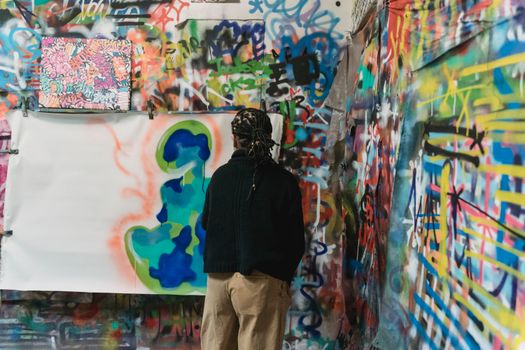
Back view of an artist exploring colorful graffiti art on a vibrant wall. Photo: Felicity Tai / Pexels
Interpreting abstract art can feel daunting because there's no obvious 'story' or 'subject' to latch onto. However, this very openness is its strength. Instead of asking 'What is it?', a more fruitful approach is to ask 'What does it do?' or 'How does it make me feel?' The key to unlocking the meaning of abstract art lies in shifting your perspective from literal recognition to sensory and emotional engagement. Start by observing the formal elements: color, line, shape, texture, and composition. How do the colors interact? Are they vibrant and clashing, or muted and harmonious? Do the lines suggest movement, tension, or calm? Are the shapes organic and fluid, or geometric and rigid? Does the texture invite touch, or does it create a sense of distance? These elements are the artist's vocabulary, and understanding their interplay is crucial. For instance, a dominant use of red might evoke passion or anger, while cool blues and greens could suggest tranquility or melancholy. Sharp, jagged lines might convey aggression or energy, whereas soft, flowing curves could imply grace or peace. Consider the overall composition: Is it balanced or asymmetrical? Does it draw your eye to a particular point, or does it encourage your gaze to wander? An unbalanced composition might intentionally create a sense of unease or dynamism. Beyond the visual, allow yourself to connect with the work on an emotional level. Does it evoke a memory, a mood, or an abstract concept like freedom, chaos, or order? There's no single 'correct' interpretation; your personal response is valid and integral to the artwork's meaning. Researching the artist's background, their statements, or the historical context can also provide valuable clues. For example, knowing that an artist created a piece during a period of intense personal struggle might inform your understanding of its emotional intensity. Finally, remember that abstract art often invites contemplation rather than immediate comprehension. It's an invitation to explore, to question, and to engage in a dialogue with the artwork. The process of interpretation is an active one, making the viewer a co-creator of meaning. It's about finding your own connection, letting the art speak to your inner self, and embracing the subjective journey it offers within the broader realm of artistic expression. This deeply personal engagement is precisely why abstract art continues to captivate and challenge audiences worldwide.

Common Misconceptions and Tips for Enjoying Abstract Art
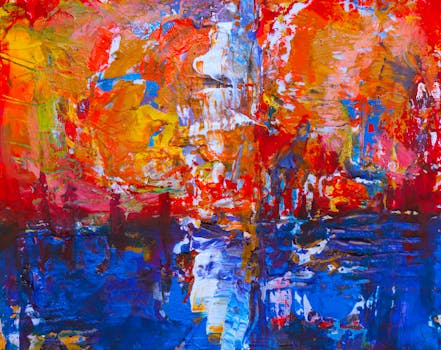
Colorful abstract painting with vivid acrylic strokes on canvas. Photo: Steve A Johnson / Pexels
Despite its pervasive presence in galleries and homes, abstract art still faces several common misconceptions that can hinder appreciation. One of the most prevalent is the idea that 'anyone could do it,' often implying a lack of skill or effort. This overlooks the deep theoretical understanding, compositional mastery, and emotional intention often underpinning abstract works. While the final product may appear simple, the journey to achieve that simplicity or complexity is often the result of years of practice and conceptual development. Another misconception is that abstract art lacks meaning or is merely decorative. As we've explored, the meaning of abstract art is often profound, albeit communicated through non-representational means. It delves into universal human experiences, emotions, and philosophical concepts that transcend literal depiction. Dismissing it as 'just pretty colors' misses the rich dialogue it aims to initiate with the viewer. A third common hurdle is the expectation of finding a recognizable subject. When viewers approach abstract art with the same lens they use for a portrait or landscape, they often feel frustrated or confused. The key is to release this expectation and embrace the art on its own terms. Here are some tips for a more enriching experience: * **Let Go of Expectations:** Don't try to find something literal. Allow your mind to wander and react to the visual stimuli without pressure to identify objects. * **Focus on the Elements:** Spend time observing the colors, lines, shapes, and textures. How do they relate to each other? What patterns or rhythms emerge? * **Tune Into Your Feelings:** What emotions or sensations does the piece evoke? Does it feel energetic, calm, chaotic, harmonious? Trust your gut reaction. * **Read the Title (if any):** While not always a direct explanation, a title can sometimes offer a hint into the artist's intention or a starting point for your interpretation. * **Research the Artist:** Knowing about the artist's life, philosophy, or other works can provide valuable context for understanding their abstract pieces. * **Consider the Context:** Where is the art displayed? What other works are around it? The environment can subtly influence how you perceive a piece. * **Give Yourself Time:** Don't rush. Spend a few minutes, or even longer, with a piece. Abstract art often reveals itself gradually. * **Discuss with Others:** Sharing your interpretations with friends can open up new perspectives and deepen your understanding. * **Experiment with Creation:** Trying to create your own abstract art can be a powerful way to understand the challenges and decisions artists face. By adopting these approaches, you can move beyond initial apprehension and discover the immense beauty and intellectual stimulation that abstract art offers.

Comparison

AspectAbstract ArtRepresentational ArtConceptual Art
Primary FocusForm, color, line, texture, emotionDepiction of recognizable subjectsIdea or concept over aesthetic
InterpretationSubjective, open-ended, personalOften more objective, based on recognitionIntellectual, requires understanding concept
CommunicationVisceral, emotional, symbolicNarrative, descriptive, literalTheoretical, textual, often ironic
Viewer EngagementActive, introspective, imaginativeObservational, appreciative of skillAnalytical, critical, requires thought
Historical ContextEarly 20th century onwardsAncient to modern, dominant until 20th C.Mid-20th century onwards

What Readers Say

"This article completely transformed my understanding of the meaning of abstract art. I used to feel intimidated, but now I feel equipped to engage with it on a deeper, more personal level. It's truly eye-opening."

Eleanor Vance · New York, NY

"As an aspiring artist, I found the historical context and interpretation tips incredibly valuable. This piece clarifies so much about why abstract artists create what they do, enhancing my own creative process."

Marcus Chen · Los Angeles, CA

"I always struggled with abstract paintings, but after reading this, I visited a gallery and actually felt a connection! The advice to focus on emotions rather than objects was a game-changer, resulting in a much richer experience."

Sophia Rodriguez · Chicago, IL

"A very thorough exploration. While some parts were a bit academic for a casual reader, the practical tips for engaging with abstract art are excellent and have definitely improved my gallery visits. Highly recommend for anyone curious."

David Kim · Seattle, WA

"I'm a graphic designer, and understanding the principles behind the meaning of abstract art here has unexpectedly improved my own design intuition. It’s not just for fine artists; it’s about visual language itself."

Chloe Adams · Austin, TX

Frequently Asked Questions

What is the core meaning of abstract art?

The core meaning of abstract art lies in its deliberate departure from objective reality, focusing instead on communicating ideas, emotions, or spiritual states through the intrinsic qualities of form, color, line, and texture. It aims to evoke a direct sensory and emotional response, inviting personal interpretation rather than literal recognition.

Is abstract art difficult to understand?

Abstract art can feel challenging because it lacks recognizable subjects, but it's not inherently 'difficult.' The challenge often stems from approaching it with expectations meant for representational art. Once you shift to engaging with its formal elements and your emotional responses, it becomes a deeply rewarding experience.

How do I start interpreting an abstract painting?

To start interpreting, first, observe the colors, shapes, lines, and textures without trying to identify objects. Pay attention to the emotions or sensations these elements evoke in you. Consider the overall composition and any available context about the artist or title to inform your personal connection to the piece.

Does abstract art have any value?

Absolutely. Abstract art holds immense value, both culturally and financially. It pushes the boundaries of artistic expression, challenges perception, and offers a unique avenue for emotional and intellectual engagement. Its value is often tied to its historical significance, artistic innovation, and the artist's reputation, commanding high prices in the art market.

How does abstract art compare to conceptual art?

While both can be non-representational, abstract art primarily focuses on visual elements and their emotional or aesthetic impact. Conceptual art, on the other hand, prioritizes the idea or concept behind the artwork above its aesthetic form or material execution. The 'art' in conceptual art is often the idea itself, not necessarily the object.

Who should engage with abstract art?

Anyone and everyone can engage with abstract art! It appeals to those curious about unconventional forms of expression, individuals seeking a deeper emotional or intellectual connection with art, and anyone open to challenging their perceptions of beauty and meaning. There are no prerequisites for appreciation.

Is there a 'right' or 'wrong' way to feel about abstract art?

There is no 'right' or 'wrong' way to feel about abstract art. Its strength lies in its subjective nature. Your personal emotional response, thoughts, and interpretations are entirely valid. The artwork acts as a catalyst, and the meaning often emerges from the interaction between the piece and your unique internal landscape.

What is the future trend for abstract art?

The future of abstract art continues to be dynamic, with trends exploring digital forms, interactive installations, and new material experimentations. Artists are increasingly blending traditional abstract principles with technology and addressing contemporary social and environmental themes, ensuring its continued evolution and relevance in the modern world.

Embark on your personal journey to unravel the profound meaning of abstract art. Let this guide empower you to see beyond the canvas and connect with the vibrant, emotional world of non-representational expression. Start exploring today and discover the endless interpretations that await.

Topics: meaning of abstract artabstract art interpretationhistory of abstract arttypes of abstract artunderstanding abstract art
Leo List

IE Escorts NO Escorts US Escorts NZ Escorts AU Escorts
Brampton weed
Adultwork EstrelaBet Vai de Bet R7 Bet Betão Galera Bet Rainbet Bet9ja Shop SportyBet BetKing Sisal Loto Foot Hollywoodbets YesPlay Odibets RushBet Jugabet BetWarrior BetCity MSport betPawa Fortebet